
Before the First Call: A DTC Brand's Prep List for a China OEM
The first call with an OEM in China is usually over in forty minutes, and what happens in it decides whether you get a real quote or a polite range. Brands that arrive with a defined product, a volume band, a landed cost target and a compliance scope get specific answers; brands that arrive with an idea get a catalogue. Preparing the six items below before the call is the cheapest work in the whole project, and it is the difference between a supplier quoting your product and quoting a generic one.
Key takeaways
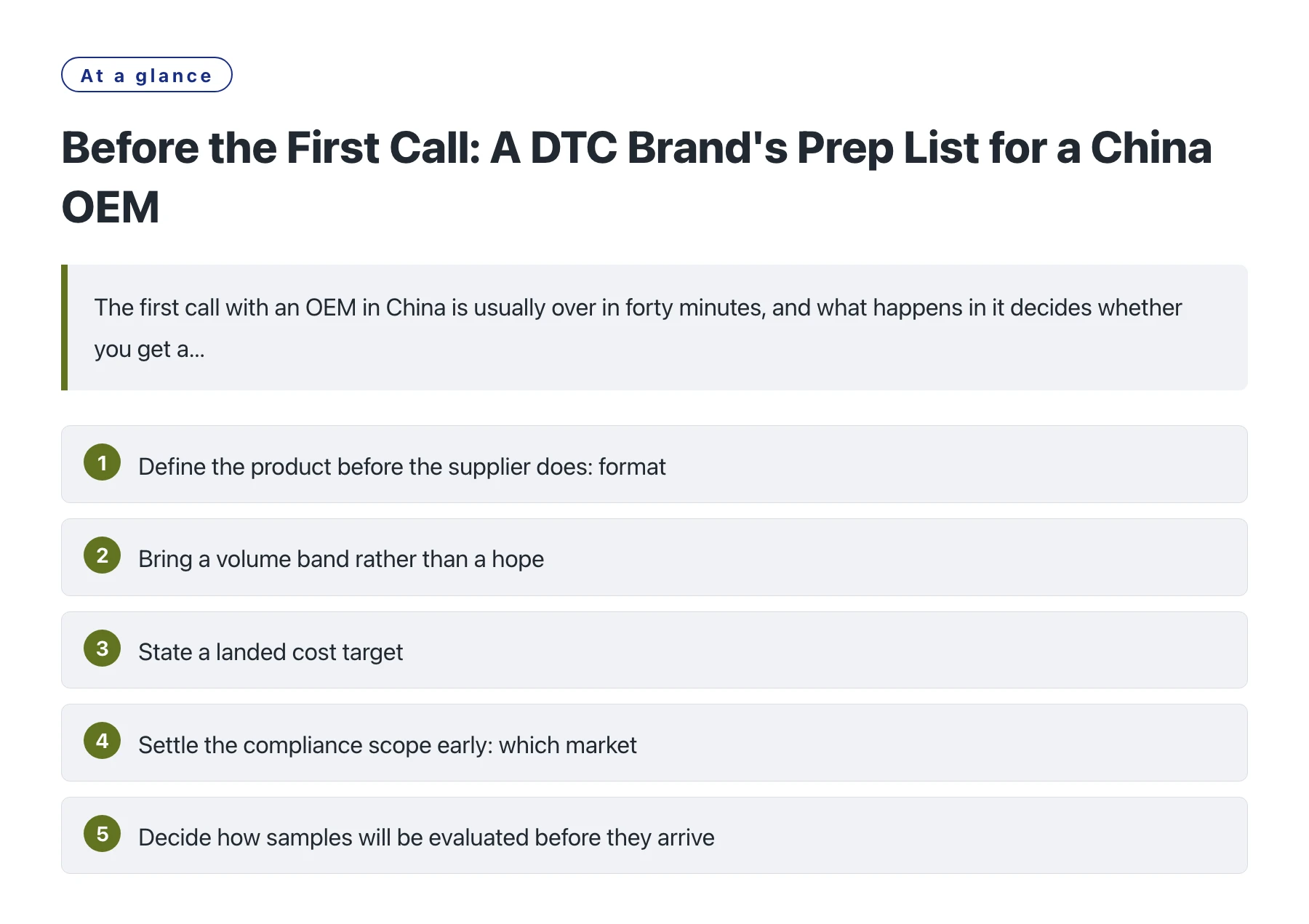
- Define the product before the supplier does: format, pack size, concentration, application and the market it will be sold in, all in one page.
- Bring a volume band rather than a hope, because minimum order quantity, material pricing and packaging tooling all behave differently at different scales.
- State a landed cost target, not a factory price target, so the conversation starts with freight, duty and secondary packaging already accounted for.
- Settle the compliance scope early: which market, which claims and which documents the retailer or platform will require [1].
- Decide how samples will be evaluated before they arrive, including who scores them, on what dimensions and against what reference.
Most disappointing first calls fail for the same reason: the buyer is still deciding what the product is. A supplier can work with an uncertain brief, but it will resolve that uncertainty in the direction that is easiest to manufacture, which is rarely the direction the brand intended. The fix is to finish the product definition in advance, even if some numbers are provisional.
A direct-to-consumer brand has a particular advantage here. Because it sells through its own channels, it can define the pack, the price and the story without waiting for a retailer to approve a listing. That freedom is also a trap: nothing forces the decision early, so it drifts into the sampling phase, where every unresolved choice becomes a revision.
Below is the preparation that turns a first call into a working session, followed by the two items buyers most often forget and the reason each one is expensive to discover later [2].
Six things to have ready before you dial in
- A one-page product definitionFormat, pack size, fragrance concentration, application and target price band on a single page. If the format is still open, bring the two candidates and the reason each is on the list.
- A volume band with a first-order floorThe quantity you intend to order first and the quantity you expect in year one. A range is acceptable; a single optimistic number is not, because the supplier will price against it.
- A landed cost targetWork backwards from the price a customer pays, subtract channel margin, freight, duty and platform fees, and bring the number that remains for the product itself.
- The compliance scope in writingWhich markets the product will be sold in, which claims the marketing will make, and which documents the retailer, marketplace or importer has asked for [1].
- A packaging positionWhether bottles and closures come from the supplier, from your own source, or are still undecided, plus any decoration requirement that affects the schedule.
- A sample evaluation planWho scores the samples, on which dimensions, over how many days, and against which reference product if there is one.
What each item changes in the conversation
| Prepared item | What a supplier can do with it | What its absence produces |
|---|---|---|
| Product definition | Suggests a route, a fill format and a realistic schedule, and flags conflicts between the pack and the fragrance | A general catalogue and a request for more information, which resets the clock |
| Volume band | Quotes at a real tier and names the point at which price steps down or tooling becomes viable | A quote at an assumed quantity, usually optimistic, that later has to be revised upward |
| Landed cost target | Proposes a material and packaging combination that can plausibly reach the target and says where it cannot | A price with no context, leaving the buyer unable to judge whether the gap is materials, packaging or margin |
| Compliance scope | Lists the documents and tests it can supply, plus any it cannot, before sampling starts | A late discovery that a required document or test was never in scope, after artwork and filling decisions are fixed |
| Packaging position | Gives an honest lead time, separates the parts it controls from the parts it does not, and prices decoration separately | A single lead time that quietly excludes the slowest component |
| Evaluation plan | Sends samples with dosage and application notes, and holds a reference batch when a direction is chosen | Sample rounds that repeat because nobody can explain what changed or why a direction was rejected |
The table is also a diagnosis tool. If a supplier cannot use the information you brought, that is useful information in itself, and it usually shows up in a conversation with Xuelei's factory as easily as anywhere else. If the answers stay generic even after a specific brief, the fit is probably wrong regardless of price.
The two items buyers forget
Product definition, volume and cost are the obvious items, and most prepared buyers bring them. The two that get skipped both concern the back half of the project, which is why they are expensive.
The first is the document list. A brand selling direct to consumers in the European Union still has to satisfy cosmetic product rules, and the obligations sit with the party placing the product on the market, not with the factory [3]. Knowing which documents the supplier will provide, which your own responsible person or consultant must produce, and which the retailer will demand is a first-call topic. It is far cheaper to design a pack around a labelling requirement than to change artwork after printing.
The second is the comparison discipline. A first call is the right moment to agree how samples will be compared and how many rounds the price includes. Both are ordinary questions that suppliers answer readily when asked, and both become awkward when raised after three rounds have already been spent.
Bring the refusals, not just the wish list
Experienced buyers arrive with a short list of things they will not accept: a fragrance that breaks down in the pack, a material the brand considers unacceptable, a lead time that cannot be met for the launch window. Stating those constraints early saves the supplier from developing in a direction that will be rejected, and it makes the answers sharper because the boundaries are visible.
It also separates suppliers. One will argue with a constraint and explain the trade-off; another will agree to everything and then deliver something else. The second pattern is the one to watch, and a short list of the questions worth asking on the first call is a useful companion to this prep work the questions to ask a perfume factory.
Decide the sample window before samples arrive
Samples create their own momentum. Once they are on a desk, the temptation is to smell once, pick the favourite and send feedback. A better pattern is to schedule two scoring sessions several days apart, score blind against the brief, and record the reasoning rather than only the verdict. The reasoning is what the supplier can act on, and it is what stops the second round from being a repetition of the first.
A practical way to prepare is to write the one-page definition, the volume band and the document list, then read them aloud as if briefing a new colleague. Anything that needs a sentence of explanation is still a decision in disguise, and it will be made by whoever is on the other end of the call. That is the entire argument for preparing: you are deciding who chooses, not whether a choice gets made. Buyers who want the fuller question set before committing, including how filling and packing are split between parties, will find it in any honest description of one-stop fragrance manufacturing, because scope is where most misunderstandings begin.
Sources
- European Commission: Cosmetics in the EU —— The European Commission's overview of EU cosmetics rules, including the responsible person, product information file and safety report requirements.
- IFRA Standards Library (International Fragrance Association) —— The IFRA Standards Library lists the restrictions the fragrance industry applies to individual fragrance ingredients, based on safety assessments; it is the reference point for compliant fragrance formulation.
- EU CosIng — Cosmetic Ingredient Database (European Commission) —— The European Commission's CosIng database of cosmetic ingredients, listing ingredient functions, restrictions and labelling requirements under EU cosmetics law.
Frequently asked questions
What should a first-time founder say when asked about order quantity?
Give an honest range with a first-order floor and an annual expectation, and say which parts are firm. Suppliers can work with a small opening order far better than they can work with a number that turns out to be aspirational, because material purchasing and packaging tooling both depend on scale.
Should I ask for a price on the first call?
You can ask, but a price without a defined product, volume and packaging scope has limited value. If a number comes quickly, ask what it includes and what would move it most: concentrate level, packaging, decoration or quantity. That answer is more useful than the number itself.
How much detail about my brand should I share?
Share everything the supplier needs to make good technical decisions, and be deliberate about commercial detail. Product definition, market, claims and constraints all belong in the first conversation; a full brand strategy does not. A short non-disclosure agreement before the call is a reasonable and common step.
What if I do not yet know which market I am launching in?
Then make the market decision before the call, or run the call twice with the two candidate markets stated separately. Labelling, allergen declaration and packaging requirements differ by market, and a supplier that is told to cover everything will either over-engineer the pack or ask you which market matters. Both outcomes cost time.
How many sample rounds should I expect the quoted price to include?
That varies by supplier and should be confirmed in writing before development starts. What matters is knowing the count, the cost of additional rounds, and what counts as a round. A round that is really a minor adjustment to the same direction is often handled differently from a fresh direction, and the difference should be agreed in advance.