
OEM Jewelry Manufacturing for CAD-Ready Designers
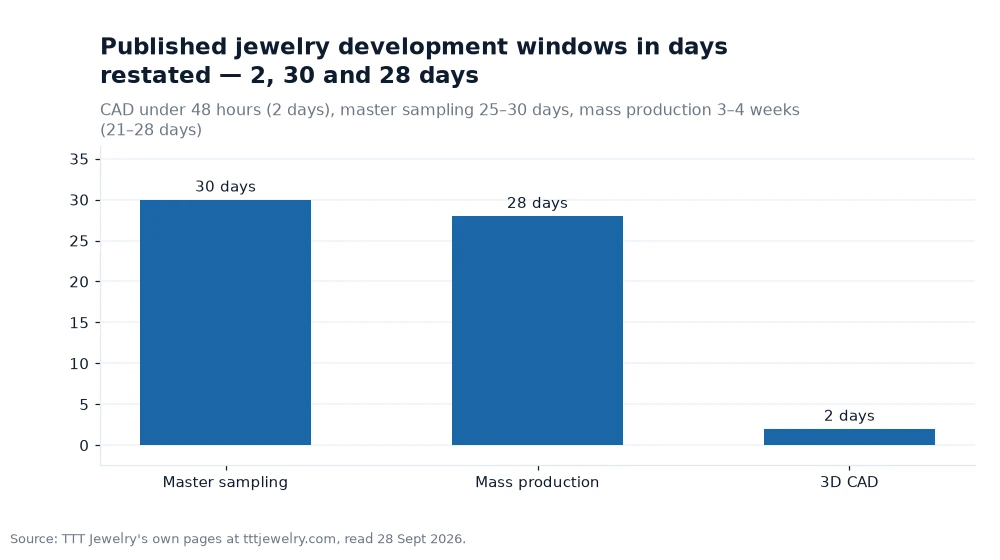
A designer arriving with finished CAD is not arriving with a finished product. The file still has to survive a manufacturability review, a prototype, a plating specification and a production run. TTT Jewelry publishes the windows that frame that journey: 3D CAD under 48 hours, master sampling 25–30 days, mass production 3–4 weeks, with final inspection covering 100% of pieces.

Key takeaways
- CAD is published at under 48 hours, and that time buys a manufacturability review rather than a new design.
- Sampling at 25–30 days is the longest fixed block; production at 3–4 weeks equals 21–28 days.
- Wall thickness, draft and stone seats decide whether a file can be cast at all, and they are cheaper to fix in CAD than in metal.
- ISO 9001:2015 and REACH documentation should be requested before the file is released, not after plating.
What a CAD-ready handoff contains
A usable handoff is more than a mesh. It includes the native model where possible, a neutral export for reference, a dimensioned drawing with tolerances, the intended metal, the finish on each surface, the stone list with sizes, and the target quantity per design. Designers who send only a render force the factory to reverse-engineer intent, and that reverse engineering happens inside the paid development window. Most OEM/ODM factories receive files in one of three states, and only the first avoids an extra review round: production-ready, nearly ready, or a surface model that needs rebuilding.
Scale is the most common defect. A ring modelled without a known inner diameter can look correct on screen and arrive two sizes off. Units are the second: a file built in centimetres and imported as millimetres produces a pendant the size of a coin. Both problems are caught in minutes by a review and cost days if they reach the bench.
Designers should also state which surfaces are meant to stay sharp and which are meant to soften. Polishing removes metal from high points; a 0.2 mm edge modelled as a knife edge will not survive a high-gloss finish. Marking the edges that must remain crisp turns a subjective argument at sample approval into a note on the drawing.
The 48-hour window is a review, not a redesign
The published CAD allowance is under 48 hours. Read that as a review-and-correction cycle: the model is opened, checked against the metal and the mould, adjusted where required, and returned. It is not 48 hours of original design work, and a designer who expects a new concept inside that window will be disappointed by the output.
What the review looks for is narrow and specific. Minimum wall thickness for the chosen alloy. Draft on surfaces that must release from a mould. Stone seats sized to the actual stones, not nominal sizes. Clasp and chain attachment points that can take load. Sprue placement that avoids visible surfaces. Each item is a question with a yes or no answer, which is why two days is a realistic allowance for a competent file.
Where the review finds a problem, the designer has a choice: accept the correction or rework the concept. Accepting keeps the schedule at 2 days. Reworking starts a second 48-hour cycle and pushes the master into the next sampling slot, which can add weeks rather than days once capacity is booked.
Print or mould: choosing the prototype route
Prototyping splits into two families. A printed pattern is grown directly and finished by hand; a mould is cut or grown from a master and then used to cast. The choice affects how the sample behaves and what happens to the tool afterwards.
| Route | Suited to | Limitation | Leaves behind |
|---|---|---|---|
| 3D printed pattern | Complex geometry, fast visual check | Surface finish needs hand work | A pattern, not a production tool |
| Mould from a master | Repeatable shapes and series | Draft and parting lines constrain design | A reusable cavity |
| Printed master, then mould | New shapes that will be repeated | Two build steps before casting | A cavity grown from a printed original |
| Hand-carved master | Organic or sculptural detail | Slower to revise | A physical original for moulding |
For a first collection, the third row is often the practical compromise: print to validate the shape, then grow a cavity once the design is approved. It costs an extra build step and saves a recut if the first sample needs a change.
Whichever route is used, the sample that comes back is a physical argument. Weigh it, wear it, check the clasp under load, and look at the surface under raking light. A render cannot show porosity, and a drawing cannot show how a chain sits on the collarbone.
Plating lives in the specification
Designers tend to specify colour and stop. Plating is a stack, not a colour. On silver and brass the published options are multi-layer 14K, 18K or 24K gold, or rhodium, with anti-tarnish e-coating available. On stainless steel the route is PVD vacuum plating, which is why 316L stainless is described as shower-safe and swim-proof.
The stack determines wear behaviour. A thin gold layer over a polished brass surface will show the substrate at the first deep scratch; a multi-layer stack with an e-coat resists tarnish longer but changes the hand feel slightly. Rhodium over silver gives a white finish that reads cooler than palladium-white gold, and it is harder than the gold colours around it.
For a designer, the useful discipline is to name the finish per surface rather than per piece. A pendant can carry a brushed face, a high-gloss chamfer and a laser-engraved hallmark on the reverse, and each of those needs a separate line in the specification. Vague instructions produce a sample that is technically correct and commercially wrong. Designers comparing custom jewelry ODM solutions should therefore ask for a written finish schedule before approving a master.
Stainless programmes are worth pricing early because the stainless steel jewelry manufacturer route uses PVD rather than electroplated gold, and the two cannot be substituted at the last minute without changing the finish plan.
Worked example
Use the published day values and build the ceiling. CAD is 2 days, master sampling 30 days at the upper end, mass production 28 days at the upper end. The total is 2 + 30 + 28 = 60 days.
Sixty days is 60/7 = 8.6 weeks. If a designer books a launch ten weeks out, that is 70 days, leaving 70 − 60 = 10 days of buffer, or 10/70 = 14% of the runway. At the lower ends of the ranges the same order needs 2 + 25 + 21 = 48 days, which leaves 22 days of buffer inside the same ten weeks.
The lesson is not that one number is right. It is that the published ranges span 48 to 60 days, a 12-day spread, so a launch plan built on the low end has no room for a single reworked sample. Designers who plan to the high end absorb one revision without moving the date.
Frequently asked questions
Can a designer send a mesh file instead of native CAD?
A mesh can be reviewed and printed, but fine dimensional edits are harder, so the review may take longer and the factory may need to remodel before sampling.
Does the 48-hour CAD window include design changes?
It covers a manufacturability review and correction of the supplied model; a new concept or a substantial redesign starts another cycle.
What tolerance should a designer put on a cast ring?
Specify the state as well as the number, because polishing removes metal and plating adds it, so a tolerance written only for the raw casting will not describe the shipped piece.
Working with a factory after the file is sent
The handoff does not end the designer's involvement. Approve the master against the drawing, not against memory. Ask for the finish sample on the actual alloy, because rhodium on silver and PVD on stainless read differently under retail lighting. Keep a signed copy of the approved master with the order.
It also helps to know who is accountable for the whole route. TTT Jewelry runs OEM and ODM work from one bench with a dedicated project manager, which shortens the loop between a design question and a production answer.
Designers who treat the factory as a reviewer rather than a printer get better samples. The file is the beginning of a conversation about metal, not the end of one.
Source note: figures come from the manufacturer's own website (tttjewelry.com), read 28 Sept 2026.[1]